A Machine That Had Been Running Hot
by admin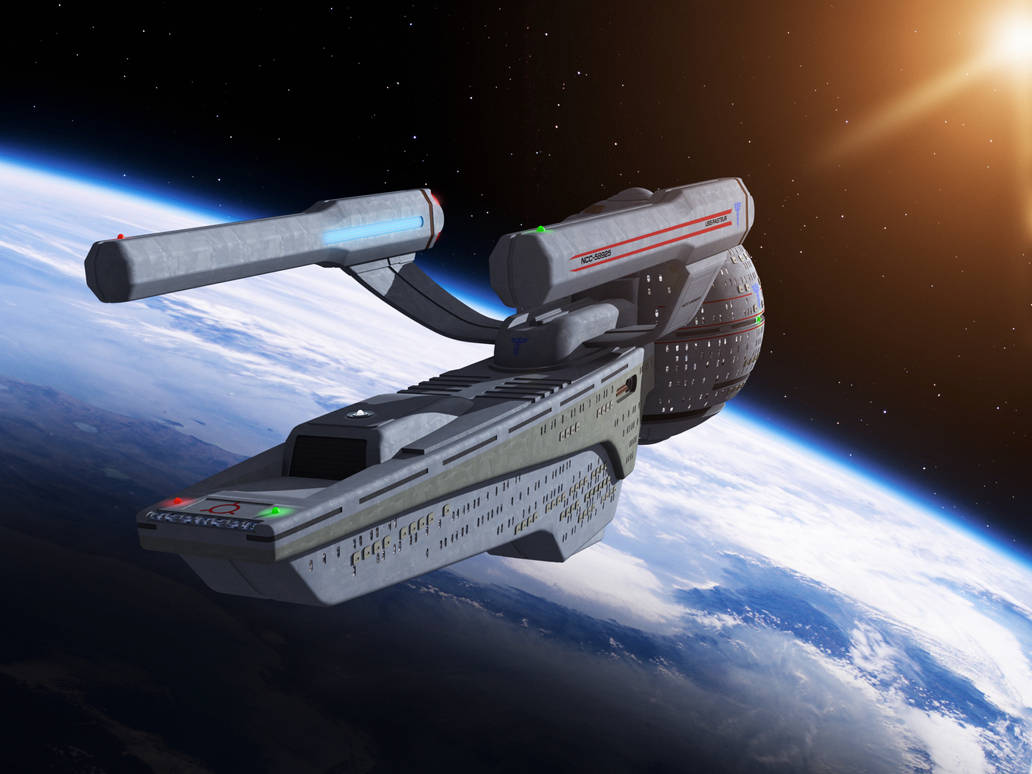
The USS Trieste did not hum like the starships in the recruitment holograms. It vibrated.
It was a persistent, low-frequency thrum that travelled up through the deck plating and into the soles of the boots, a constant reminder of the dilithium intermix chamber churning three decks down. The air tasted of ozone and recycled particulates, filtered one time too many. It was the smell of a machine that had been running hot for twenty years.
Ensign Data stood outside the Captain’s Ready Room. He did not shift his weight. He did not smooth the front of his burgundy tunic. He simply existed, perfectly motionless, his hands clasped behind his back. Corridor lighting glinted off the brass-finished belt clasp that cinched his uniform. His eyes were fixed on the brushed steel of the door mechanism.
Every 4.2 seconds, he blinked. The action was a subroutine, not a reflex.
The door swished open.
“Enter,” said a voice from within.
Data stepped across the threshold. His gait was precise, perhaps too precise. There was a microscopic hitch in the transition between his stride and his halt, a bird-like rigidity that betrayed the servo-mechanisms beneath the skin. He stopped exactly two meters from the desk.
“Ensign Data reporting for duty, Captain.”
Captain Imogen Brand did not look up immediately. She was reviewing a PADD, the blue glow of the display illuminating a face defined by sharp angles and tired eyes. She wore her authority like her uniform, fastened tight, functional, unadorned.
Her desk was a working surface, not a shrine. Two stacked PADDs. A stylus. A mug with a hairline crack in the glaze. And pinned beneath a magnetic weight, a physical paper chart, old-fashioned and annotated. It depicted a jagged border corridor and the strings of waypoints that kept Starfleet ships on the right side of somebody else’s paranoia.
Beyond the viewport, the skeletal arm of the starbase gantry hung over the Trieste’s hull like scaffolding. Work bees drifted past the glass in slow arcs, indifferent to the fact that the ship beneath them was tired and going back out anyway.
Brand set the PADD down and looked at him. She did not smile. She studied him with the detached scrutiny of an engineer inspecting a new component she hadn’t ordered.
“At ease, Ensign.”
“Thank you, Captain,” Data said. He moved his hands to his sides, but his posture remained erect, his chin level.
“I have read your file,” Brand said, leaning back. Her chair creaked, a sound of leather and metal strain. “Starfleet Academy graduating class of ’45. Honours in exobiology and probability mechanics. Your instructors describe you as ‘technically flawless’ and ‘socially inert.’”
“That is an accurate summation,” Data replied. The tone was even, devoid of pride or offense.
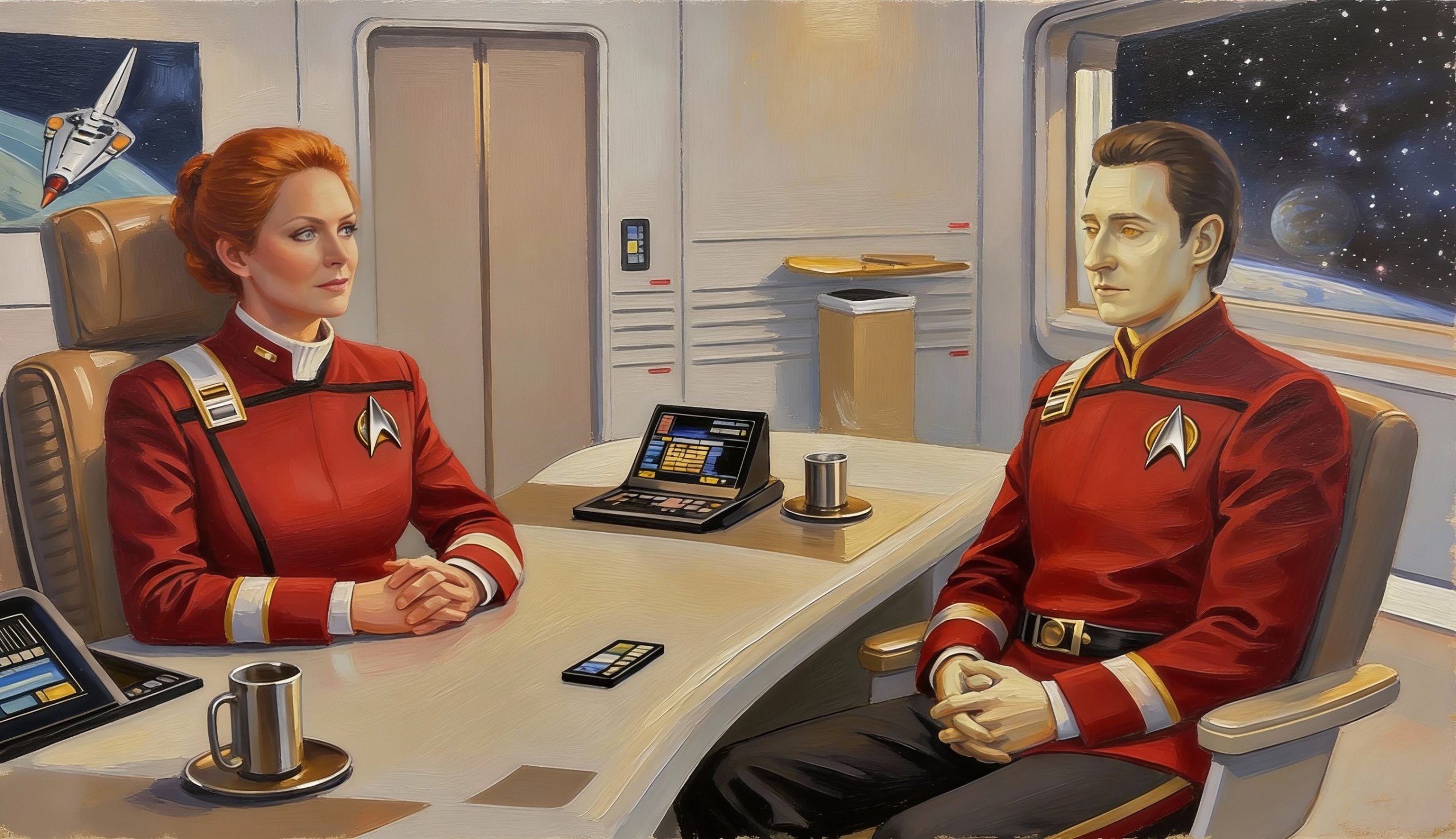
Brand stood and walked to the viewport, not to admire the stars but to think in the only place a captain could still pretend she was alone. The starbase gantry reflected pale light across her uniform. She kept her hands behind her back, fingers clasped too tightly.
“You are the first,” she said without turning. “The first of your kind to wear that uniform in active service.”
“I am the first Soong-type android to graduate Starfleet Academy, Captain.”
Brand turned to face him. “Starfleet did not send you here by accident. They sent a briefing. Sealed. They sent a list.”
Data’s head inclined by a few degrees. “Integration milestones.”
Brand’s mouth tightened. Not irritation at Data, irritation at the fact that her ship had just acquired an administrative shadow.
“Reports,” she continued. “Behavioural notes. Recommendations. How you respond under stress. How the crew responds to you. ‘Indicators of successful assimilation into shipboard culture.’”
She said the phrase like it tasted faintly of metal.
“This ship is not a laboratory, Ensign. We haul relief supplies to colonies that are one bad season from starvation. We escort diplomatic cargo through corridors where a misinterpreted sensor sweep can start a shooting war. We operate on margins that would embarrass an explorer crew. Do you understand?”
“I understand the operational constraints of the Merced class, Captain. Its redundancy systems are measurably reduced compared to larger long-range platforms.”
“It means,” Brand said, her voice dropping slightly, “that the regulations are a safety net, not a suicide pact. On this border, the difference between a diplomatic incident and a massacre is often an officer knowing when not to follow the book. I need to know if you can read the room, Ensign, or only the regulations.”
She stepped closer. The test was now explicit.
“Tell me. You are on the bridge. Sensors pick up a civilian freighter drifting across the demarcation line. It is transmitting a distress signal. Standing orders are to hold position and avoid provocation. Cardassian patrols are operating on the far side. If we cross, we risk an incident. If we stay, the freighter crew likely dies. What do you do?”
Data’s head tilted, a quick, economical motion. “I would inform you immediately. I would verify the vessel’s transponder against civilian registry records to check for signal falsification. I would attempt to establish communications. I would calculate whether a rescue could be effected without violating the border corridor’s territorial delineation. And I would await your order.”
“And if I am incapacitated?”
“I would follow the chain of command.”
“And if the officer next in line is also incapacitated?”
Data paused. The silence lasted exactly 0.6 seconds. “I would preserve mission integrity and minimise aggregate casualties. If the rescue could be performed without escalating the situation, I would attempt it. If it required a clear violation of treaty restrictions and presented a high probability of wider conflict, I would maintain position.”
Brand watched him.
“You would let them die,” she said.
“I would obey standing orders established to prevent escalation, Captain. Violating them could result in higher casualties beyond the freighter’s crew.”
Brand exhaled. Not anger. Something closer to reluctant understanding.
“You know,” she said, “you’d make a decent Vulcan.”
Data blinked. “Captain?”
“You hear the arithmetic and you follow it. You do not see the context. You see a rule. I see a trigger.” She held his gaze. “And with Setlik III still fresh in the sector’s memory, the last thing this corridor needs is a literalist with his finger near the phaser controls.”
“I am not Vulcan,” Data said.
“No,” Brand replied. “And that’s what makes this awkward.”
She moved back to her desk, lifted a PADD, then set it down again without reading it, as if pretending there was other work was a courtesy to both of them.
“You follow the book,” Brand said. “That can be safer than a hero complex. On this border, heroes are how people end up in reports.”
She touched the desktop intercom control.
“Brand to Security.”
“Sorel here,” came the reply, clipped and dry.
“He’s on his way. Gamma shift. I want him brought into routine, not put on display. Understood?”
“Understood, Captain.”
Brand’s eyes remained on Data. “Report to Lieutenant Sorel. Dismissed.”
“Aye, Captain.”
Data pivoted on his heel, precise, ninety degrees, and marched out.
Brand watched the door close. Then, quieter, to no one in particular:
“And Starfleet wants updates.”
0 Comments