The House as an Ear
by adminThe words sat there, dense and flat on the thin paper.
Kai recognised them vaguely. Sunday school, maybe. Or a funeral. The sort of line people quoted in serious voices and expected to land.
It landed now.
The small settling click the house had made behind him no longer felt incidental.
In the top corner of the page, boxed in Caius’s neat hand, was the reference: Prov. 14:12.
“You okay?” Ellie asked behind him.
“Yeah.” He shut the book a little too quickly and slid it back into place.
She watched him for a second, not buying it, then let it go. “Come on,” she said. “If there’s an attic full of cursed dolls, I want fair warning.”
They found the stairs and went up. The treads creaked predictably under their weight. The air on the landing felt colder, though that might have been the thinner windows, or just the way old houses knew how to make every degree feel personal.
There were three doors. One stood ajar. One was shut. The third had a patch of raw wood at the bottom, scarred as if something had scraped against it again and again over the years.
“For the love of God,” Ellie whispered, “don’t say claw marks.”
“Scuff marks,” Kai said. “Old house. Bad fit. Door’s been chewing the floor for years.”
“How many doors do you know that bite back?”
“Very determined ones.”
He pushed the nearest door open. Bedroom. Bed neatly made, blankets pulled tight enough to suggest either military service or general unhappiness. Wardrobe. Chest of drawers. No mess. No books. No sign that anyone had ever been halfway through anything in here.
“No personality,” Ellie said.
“Maybe that was the personality.”
The second room was similar, but lived-in in smaller ways. A desk by the window. A fountain pen. A mug with a faded cathedral logo on it. The curtains had been tied back properly, which somehow felt like character.
There was a Bible on the desk too, its black cover softened at the corners from use. An order of service had been tucked inside as a bookmark, cream card gone yellow with age. On the front, in serif print, it read: Discernment in Times of Trial.
Ellie drifted to the window and looked out over the moor. “He really lived up here and never invited Mum once,” she said. “That’s almost impressive.”
Kai picked up the notebook beside the Bible. The pages crackled faintly under his fingers.
“Should we be reading that?” Ellie asked.
“He’s dead,” Kai said. “Privacy’s a bit of a moot point.”
“You say that, but I don’t want some furious theology ghost telling me off for gossiping.”
He opened the notebook somewhere near the middle.
The handwriting matched the marginal notes downstairs: tight, disciplined, slightly old-fashioned. Not a diary exactly. More a record. Dates, observations, the sort of controlled notation people use when they’re trying not to sound frightened.
October 13th
Wind strong from east. Voices clearer. Manifestation at 3:17 a.m. at top of stairs. Same appearance. Refuses discourse beyond rote reassurance. No physiological disturbance observed afterwards, but sense of unreality persists.
October 29th
Path to cairn less stable every year. Light fails quicker. He comes more frequently when I question. Knows the shape of my doubts before I do. Temptation to assent is great. Must remember: there is a way that seems right.
There were more like that. Clinical at first. Then fraying. Certain words underlined twice, as if pressure alone might keep them pinned in place.
liar. mimicry. wrong.
Ellie leaned in over his shoulder. He felt her inhale.
“Oh,” she said quietly. “So he was mad.”
“Or methodical.”
“That is a very generous rebrand.”
He turned a few pages further on. By January, the handwriting had changed. Less controlled. More force in the downstrokes, as if Caius had started arguing with the page.
January 4th
The house feels like an ear when the wind is right. As though it is listening for him, not against him. If I had left when the urge first came, years ago, perhaps I would not hear him as clearly. There was a line, and I stepped over it, thinking I was being brave. Or faithful. Or rational.
Below that, under a second paragraph, he had written harder:
We preach that proverb as a warning about obvious sins, straight roads turning suddenly to pits. But the terror is subtler: a way that still looks right after you have been warned. A road that keeps agreeing with you while it leads you elsewhere. I am no longer certain it is a road and not a mouth.
Ellie made a face. “Nope.”
Kai kept reading.
January 9th
The voice adjusts itself like a good sermon. It takes my own phrases and feeds them back to me with the edges smoothed off. Sometimes it feels like my own thoughts, repeated back with a half-second delay. Sometimes like no one in particular, only familiar enough that I do not question it until afterwards.
Then, a line below, underlined once:
Even the serpent in Eden did not say “Go,” but “Has God said.” Deception begins with agreement.
Kai stared at that for a second.
It was the sort of line he would normally have dismissed as the private drama of an overworked religious mind. Out here, in this room, with the moor pressed flat against the window, it felt less like drama than a clean description of something he had not yet chosen to believe in.
January 12th
He sat at the bottom of my bed again. No spectacle. Simply a presence content to agree. Spoke softly of peace, of rest, of how nothing needed to change. No directives, only yes, whispered back as if I had said it first. It is a doctrine of stillness preached as faithfulness. A theology of surrender by inches. That is what frightens me.
January 19th
Wind high. Moor restless. Heard something move in the walls. Or beneath the floorboards. It may be the plumbing. It may be him looking for other ways in. If he can wear my thoughts, why not the house? Why not the landscape? I no longer trust which noises are the house and which are me.
Kai closed the notebook very carefully.
Ellie looked at him. “Well,” she said. “That’s normal.”
“Lots of elderly people get eccentric.”
“Eccentric is wearing three hats,” she said. “This is talking about the house like it’s an organ.”
“Poetic, then.”
“Creepy poetic.”
He set the notebook back on the desk beside the Bible. The order of service peeked out slightly, its title still visible. Discernment in Times of Trial.
Very on brand, he thought, and immediately disliked himself for thinking it.
“I’ll take the sofa,” he said abruptly. “You can have this room tonight.”
“You’re not leaving me alone with his ghost diary,” Ellie said. “Absolutely not.”
“The other room, then.”
“Better.”
She dumped her bag in the front bedroom, leaving Kai with the desk room and its neat, accusing notebook.
They tried the third door.
Locked.
Not just locked, either. Someone had driven long screws into the frame around the keyhole, as if ordinary privacy had stopped feeling adequate at some point.
Ellie folded her arms. “Okay. That’s not ominous at all.”
“Probably just junk.”
“With reinforced anti-junk screws.”
Kai tried the handle anyway. It rattled once and held.
Nothing answered from the other side. That was somehow worse.
“Can we not?” Ellie said. “If you break it open and a swarm of bats flies out, I’m going back to the car and leaving you here with your inherited theology.”
“Very loyal.”
“Exceptionally.”
Kai let the handle go.
Ellie took a step back from the door as if it might remember her. “I just want it on record,” she said, “that if this turns into one of those stories where the sensible sister dies first, I’ll be furious.”
“Noted,” Kai said. “I’ll put it in the incident report.”
“Thank you. I appreciate professionalism in a crisis.”
They did one more sweep of the house: back door, windows, radiators, the sort of practical checks that made places seem smaller and more manageable. The heating coughed reluctantly into life, pipes ticking inside the walls. Outside, the daylight had already started thinning. Out here dusk did not arrive so much as remove options.
By the time they dumped their bags in the rooms and went back downstairs, the sky beyond the kitchen window had flattened into a hard, colourless grey. Kai stood there a moment looking out.
In the city, evening came with signals. Street lamps, windows, traffic, people continuing to exist whether you joined in or not. Here, the dark simply gathered itself.
The house felt like a lone ship in black water.
Behind him, Ellie rummaged through cupboards. “We’ve got tea,” she announced. “And some tins that look older than me.”
“Tea’s enough.”
“Spoken like a proper northerner.”
They heated soup on the hob and ate it at the kitchen table, hunched over steaming bowls like pensioners trapped in a low-budget advert. The heater worked hard and achieved very little.
“So,” Ellie said, scraping her spoon round the last watery bits. “Do you think he came up here because he was hearing voices, or started hearing voices because he came up here?”
“Bit of both, probably,” Kai said. “Feedback loop.”
The phrase sounded thin in the kitchen, like something said for the benefit of a room that had already chosen a different explanation.
“You always make it sound so clinical,” Ellie said. “Feedback loop. Cognitive distortion. Never maybe there’s something weird in the walls.”
“You want weird?” he said mildly. “Fine. Maybe the house is an ear and the moor is a mouth and Uncle Caius spent his retirement being gaslit by the landscape.”
She grinned despite herself, then let it fade. “You joke, but it does feel…”
“Watchful,” Kai said before she could.
Ellie looked up. “Yes.”
He hadn’t meant to say it. The word had simply arrived, ready-made.
That annoyed him more than it should have.
“That’s you projecting,” he said a second later, though it sounded thinner now.
“Or noticing.”
He was about to answer when he stopped.
Something had changed.
“What?” Ellie whispered at once.
He held up a hand.
The fridge hummed. Wind worried at the eaves. Somewhere deep in the pipes, water ticked.
Then it came again: a definite crunch of footsteps outside. Slow. Measured. Not the random scatter of branches or gravel shifting in the weather. Deliberate weight.
Ellie’s eyes widened. She mouthed, See?
Kai got up, his chair scraping sharply on the tiles. “Stay here.”
“Obviously not.”
They moved together into the hall. The frosted glass in the top half of the front door burned faintly with reflected porch light.
Kai opened it three inches and squinted into the wind.
A figure stood by the low wall, back to the house, facing the moor.
For a second he thought it was a post or a trick of the dark. Then it shifted.
“Hello?” he called.
The figure turned.
A man. Mid-forties, maybe. Weathered face, dark hair with grey in it, heavy brown coat, flat cap low over washed-out green eyes. The sort of face that looked trustworthy because it had been assembled from pieces that usually were.
“Evening,” he said. His voice carried oddly clearly through the wind, as if it had found a gap in it. “Didn’t mean to startle you.”
“Can we help you?” Kai asked.
The man smiled. Not warmly. Not coldly either. Just enough. “I’m Tom,” he said. “From down the lane.”
Kai glanced at Ellie.
“There’s no other house down the lane,” she whispered.
“Right Way Farm,” Tom said, as though he had heard her perfectly. “Two miles further on. Doesn’t show up on satnavs half the time.”
He stepped a little closer to the porch, not enough to seem intrusive. Just enough that he could look as though he belonged there.
“Caius mentioned you might come,” he said. “His nephew and niece. Kai. Ellie.”
He said their names without any searching for them.
Kai’s fingers tightened on the door edge.
“He told you about us?”
“Ages ago,” Tom said easily. “Said you’d turn up eventually. Said you’d be curious.”
Ellie moved slightly in front of Kai without seeming to mean to. “You were his friend?”
“Neighbour,” Tom said. “But yes.”
Neighbour. On a lane that had looked like the edge of the world when they drove it.
Plausible, Kai thought. They might have missed a track. A farmhouse sunk low into the land. A bend. Something obvious that only became obvious once you were told.
Plausible, but a little too neat.
“Mum never told us much about him,” he said. “We didn’t know anyone else was out here.”
“Few and far between,” Tom said. He tilted his head, taking them in. “How are you finding it? The place?”
“Cold,” Ellie said before Kai could answer.
Tom’s mouth twitched. “Different sort of cold up here. Gets in where you don’t think you’ve got any gaps.”
“We’re only here a couple of nights,” Kai said. “Just sorting things out.”
“Plenty of time,” Tom said. “No sense rushing a decision.”
Something in the phrase bothered Kai at once, though he could not have said why. It was reasonable. Helpful, even. The sort of thing anyone might say.
That was the problem with it.
“Mmm,” Tom added, glancing past them into the hall with the air of someone checking a room he had seen before. “You’ll be safe enough. So long as you don’t go wandering after dark.”
“Because of bogs?” Ellie asked.
“Because of bogs,” he agreed. “And holes. And the way sound carries. You hear things where they’re not. Think something’s ahead and it’s behind. Or nowhere at all.”
The wind tugged at his coat. He didn’t seem to notice.
Kai thought of the notebook upstairs. The house feels like an ear. Deception begins with agreement. A road that keeps agreeing with you while it leads you elsewhere.
He cleared his throat. “Did you see him much? Before he…”
“Passed on?” Tom supplied. “Often enough. He’d come down some evenings. Or I’d walk up. We’d drink tea, solve all the world’s problems. He was a good man. Stubborn. Thought too much. Listened more to the wrong things than the right, in the end.”
“The wrong things?” Ellie said.
Tom looked at her for a moment too long. Not rudely. Just with the steady attention of someone deciding what version of the truth would be most useful.
“Voices,” he said lightly. “You know how it is up here. Nothing to distract you. Mind starts filling the quiet.”
Then he looked back at Kai.
“If you need anything, you follow the lane past the old cattle grid and keep left where it forks. Looks like you should go right, but that way’s fallen into the bog. Left looks worse, but it’ll keep you dry.”
“Got it,” Kai said.
Tom tipped two fingers from the brim of his cap. “You’re doing the right thing, you know. Coming here yourselves. Better to see. Then you’ll know what to do.”
The words slid into Kai with uncomfortable ease. For one stupid second they felt like relief. Yes. Exactly. Sensible. Responsible. The right thing.
“You’ll be alright,” Tom said softly. “You were meant to be here. Both of you.”
The wind gusted hard between them. Kai blinked, and when he focused again Tom was already walking away along the wall, coat snapping behind him.
He did not look back.
“Two miles,” Ellie muttered. “In this? Sod that.”
Kai watched until the man had been swallowed by the moor.
“He seemed nice,” Ellie said. “Normal. Slightly dull. The hat’s doing most of the evil.”
“Yeah,” Kai said slowly. “Normal.”
The word didn’t fit. Tom had felt normal in the same way a brochure cottage feels cosy: every piece arranged in the right place, nothing truly lived in.
He shut the door.
Inside, the lights seemed dimmer after the pale smear of outside. The house exhaled softly around them.
Ellie paused in the hall and rubbed her arms. “Did you feel that?”
“What?”
“Like when you’ve had the telly on for ages and then turn it off and the room’s wrong for a second. Too quiet.”
“Old pipes. Wind. Dead vicar whispers.”
She half-smiled, but her eyes drifted upward to the landing.
Kai followed her look.
The locked door upstairs felt closer than it had before, though that was impossible.
He told himself that.
Later, in the desk room, he lay awake longer than he meant to.
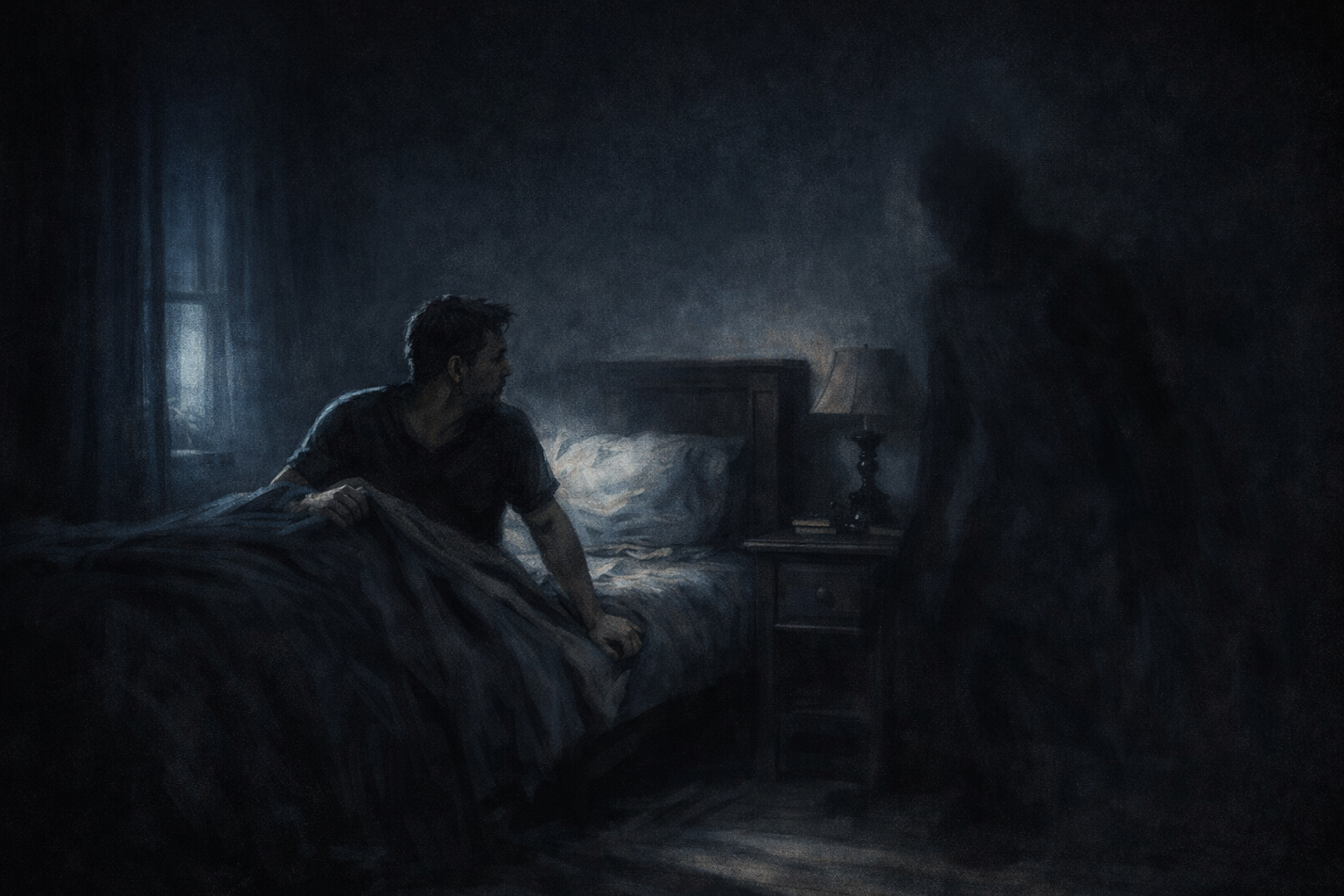
The notebook sat where he had left it, a darker square on the desk. Moonlight kept failing behind cloud. Each time the light changed, the room seemed to rearrange itself slightly: not enough to prove, only enough to notice.
He listened to the house adjust itself around the weather. Ticks in the pipes. Small knocks in the walls. A board on the landing settled somewhere beyond the door, which made no sense at all.
At some point he drifted.
Then, in the black small hours, Kai woke to the sound of the house climbing the stairs.
0 Comments