Reaction Time
by adminThe shuttle bay of the USS Trieste was a cavern of acoustic violence.
Unlike the relatively clean corridors near the command deck, the bay was raw industry. The deck was scarred plasteel, scuffed by landing skids and the boots of loaders. It smelled of hydraulic fluid and hot metal. The atmospheric forcefields hummed with a headache-inducing whine, holding back vacuum while a Type-6 shuttle underwent engine maintenance beneath an open access panel.
Data stood by a maintenance console, inputting diagnostic sequences. He had been aboard for six hours. He had logged the location of every fire suppression unit and noted the phase-variance in the ship’s main computer. The duotronic relays were sluggish, showing a 0.04% lag in processing efficiency compared to the newer processing stacks appearing in fleet refit programmes. Some yards were even trialling isolinear circuitry in non-critical subsystems.
“Hey, watch the swing!”
Data turned his head.
Two crewmen in beige enlisted jumpsuits were guiding a heavy cargo pod toward the magnetic locking clamps on the far bulkhead. The pod was a reinforced vacuum-rated container, a rectangular prism of dull metal and warning stencils, weighing approximately three metric tons.
“Easy,” muttered Crewman Halloway, wiping grease from his forehead. He operated the manual gravity dolly. “Mag-locks on grid four are sticky again.”
“Just seat it,” said the other, Miller. Not angry. Impatient. “Shift’s over in ten.”
Data observed the alignment.
“Crewman,” he said, voice carrying over the din. “The cargo pod is 3.4 degrees off the center axis of the clamp. Engagement at this angle risks uneven torque and accelerated fatigue on the upper locking flange.”
Miller glanced back, expression flat. “Noted, Ensign.”
It is not a note. Data’s tone did not change. “It is an engineering constraint.”
Miller pushed the dolly forward anyway. The cargo pod thumped against the bulkhead. The magnetic clamps engaged with a heavy, satisfying sound.
“Green,” Miller said. “See? No drama.”
Data’s gaze flicked to the diagnostic readout.
“The sensor indicates a lock. However, stress variance on the upper flange is increasing beyond tolerance.”
“It’s an old ship,” Halloway said, already turning away. “Everything’s beyond tolerance.”
The sound that followed was not loud.
It was a sharp, metallic ping, high-tensile tritanium giving up under a load it had been asked to carry one time too many.
Data’s head snapped toward it. His auditory subroutines isolated the frequency and identified the failure mode.
“Move,” Data said.
“What?” Miller turned back.
The upper clamp failed.
It did not simply open. It fractured. The three-ton cargo pod, no longer held flush to the bulkhead, pitched forward as the dolly’s support shifted. It began to fall, not straight down but forward and toward the work zone where Halloway stood, one boot still half-turned as he tried to understand what his ears had just told him.
Time did not slow. Humans did.
A chemical delay, fractions of a second, was the gulf between recognition and motion. Halloway’s mouth opened. His eyes widened. His legs remained locked.
Data did not freeze. He did not fear. He acted.
He moved with a speed the human eye could not meaningfully track.
One moment he was at the console. The next, he was simply there, inserted into the space between Halloway and death. There was no wind-up. Just a sudden displacement of air and a snap of burgundy uniform that sounded like a whip crack.
He did not try to catch the pod.
Catching it would have driven the full load into a single point, into the bay deck, the conduit runs beneath it, the local gravity grid, and the gantry track overhead. On a ship like the Trieste, that was how you turned one accident into five.
Instead, he shoved Halloway.
It was not a gentle push. Data’s hand struck Halloway’s chest with calculated force, launching the crewman backward and out of the crush zone. Halloway hit the deck hard and skidded, winded but alive.
In the same motion, Data stepped into the fall line and braced.
He planted his shoulder under the descending corner, not to hold it forever, but to arrest the angle. He prevented the container’s edge from shearing into the gantry rail and tearing through the exposed shuttle maintenance line.
Metal met metal.
The impact did not ring. It boomed.
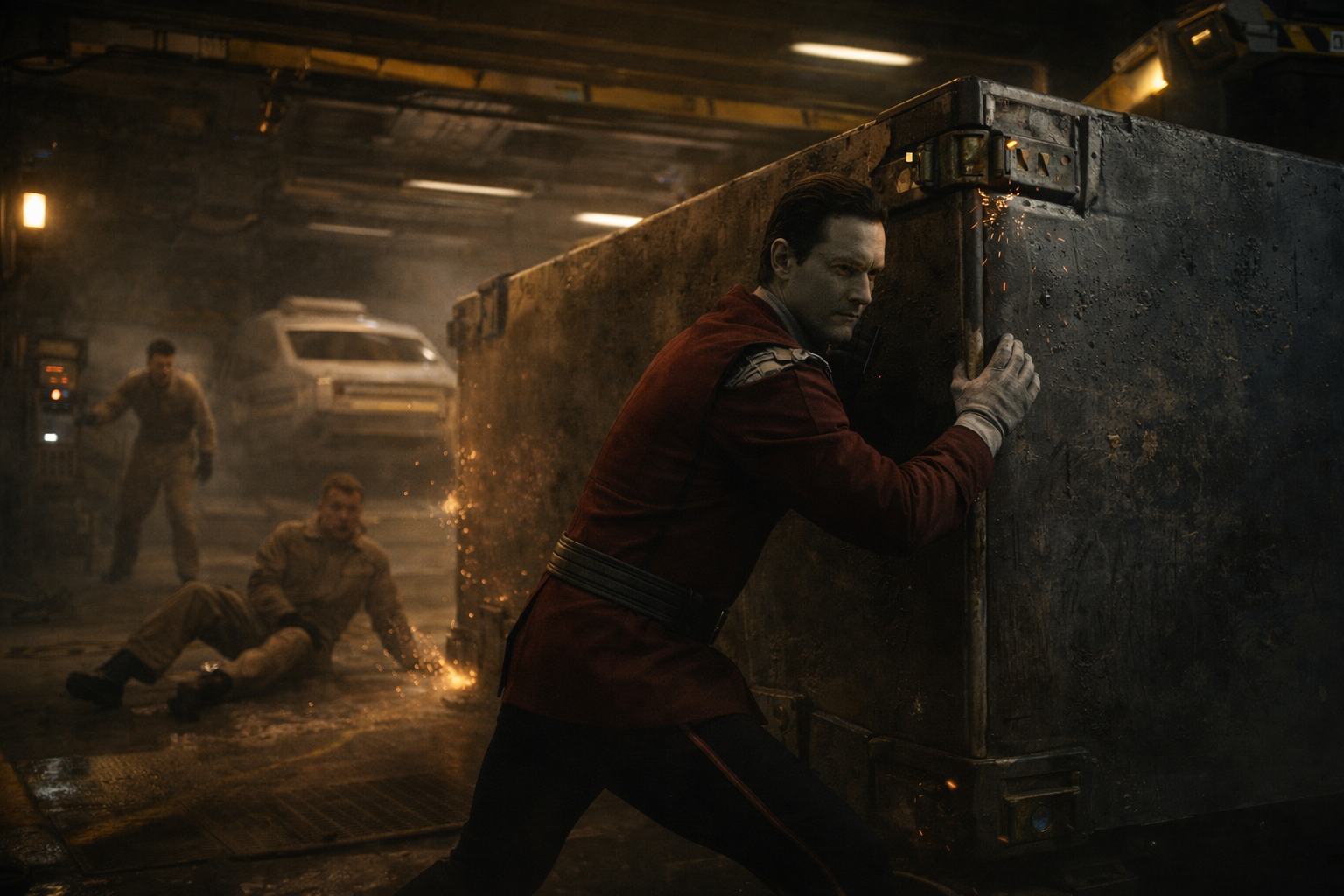
Sparks spat from an overhead conduit as vibration travelled through the bay frame. The pod’s corner dented inward with a brutal, ugly compliance. Data’s uniform tore at the seam. The skin at his shoulder compressed, then rebounded with a shallow crease that looked, for one unsettling instant, like flesh had been asked to behave like metal.
Silence rushed back in behind the noise, punctuated only by the hiss of a ruptured hydraulic line and Halloway’s ragged breathing.
Data stood bent at the waist, knees slightly buckled, supporting the corner long enough to keep it from tipping into worse damage.
“Crewman Miller,” Data said. His voice was unchanged. No strain. No breath. “Engage the emergency tether on the overhead gantry. The local gravity grid is destabilising. I cannot maintain this angle indefinitely.”
Miller stared, mouth open.
“Now,” Data added, not louder, simply final.
Miller moved. Hands shaking, boots slipping on the scarred deck, he slammed the control panel. The yellow beam of the tractor tether snapped onto the pod with a rising whine as the gantry took the weight and lifted it back toward the bulkhead.
“Lift confirmed,” Miller breathed, as if he had only just remembered how lungs worked.
Data stepped out from under the pod. He straightened his tunic as much as torn fabric permitted. He brushed a flake of grey paint from his shoulder with careful, unnecessary precision.
The bay doors hissed open.
Lieutenant Sorel strode in, posture immaculate. Young, lean, close-cropped black hair. His expression was neutral in the way only Vulcans could manage, not empty—sealed.
“Report,” Sorel ordered.
“Mechanical failure of magnetic clamp Alpha-Four,” Data said. “Crewman Halloway was within the crush zone. I removed him. I prevented secondary damage to the overhead gantry track and adjacent maintenance lines.”
Sorel’s gaze shifted to Halloway, who was being scanned by the medic, then to the cargo pod’s dent.
“You supported it,” Sorel said.
“I reduced its descent rate and controlled its angle,” Data corrected. “I did not support it indefinitely. That would have been inefficient and potentially damaging to ship systems.”
Halloway tried to sit up, grimacing. “He shoved me and I was flying,” he wheezed.
“You are alive,” Data said.
Miller swallowed. “He moved so fast. I didn’t even… I didn’t see him move.”
Sorel turned to Data.
“You detected the failure before the sensors registered the break.”
“The acoustic signature of metal fatigue was audible 1.2 seconds prior to fracture,” Data said. “I attempted to warn them. Their response time was insufficient.”
“Because they are human,” Sorel said, dry enough to rasp. “And they do not process auditory input at your rate.”
Data blinked.
“Human reaction latency is measurably longer than my own.”
The silence in the bay changed.
It was no longer the silence of shock. It was the silence of calculation, of people realising what they had witnessed did not come with an obvious category.
Sorel’s eyes flicked to the torn seam.
“Report to Sickbay,” he said. “Have Medical repair the dermal abrasion and confirm internal alignment. And Ensign.”
“Sir?”
“Do not make a habit of interposing yourself between mass and gravity. Next time, use the gantry first.”
“Aye, sir.”
Data paused, then added, almost clinically: “My initial warning was not heeded.”
Sorel’s brow lifted by a fraction. “Then you will adjust your delivery until it is.”
“Acknowledged.”
The departure announcement came without ceremony.
“All hands,” the shipwide voice intoned, neutral and uninflected. “Prepare for departure. Docking clamps release in thirty seconds.”
The vibration beneath the deck changed character. Not louder, but deeper. The Trieste stopped borrowing power from the station and began relying on herself. Somewhere aft, the intermix chamber adjusted its rhythm. The low thrum sharpened, becoming intent rather than background.
From the bridge, Captain Brand watched the starbase gantry withdraw, its lights sliding slowly out of alignment with the forward viewport. The skeletal arm that had loomed over the hull for days peeled away, leaving bare starlight in its place. Work bees scattered, clearing the departure lane. The last umbilical disengaged with a muted shudder that travelled through the frame.
“Thrusters online,” Ops reported.
“Inertial dampers nominal.”
“Clear of docking perimeter.”
“Take us out,” Brand said.
The Trieste moved.
It wasn’t graceful. The ship eased forward like a freighter leaving harbour, mass asserting itself before momentum took over. The starbase receded, becoming just another light behind them. Ahead lay the corridor, dark, quiet, politically charged space where sensors lied by omission and every contact mattered.
Data stood at his assigned position, posture exact. He logged the transition automatically: station-assisted to independent operation, power draw redistribution, subtle increase in crew vocal tension. The ship had shifted from protected space to contested transit.
Mission status: active.
The mess hall on the Trieste was small, smelling faintly of burnt coffee and reconstituted tomato soup.
It was the social heart of the ship, where the engine vibration became background rather than reminder.
When Data entered, the volume dropped by half.
He moved through the room with the same exactness, but without haste. He selected a nutrient supplement. He did not require it, but his programming suggested social integration was facilitated by shared rituals. He found an empty table in the corner.
He sat. He placed his hands on the table. He did not slouch.
Across the room, Halloway sat with a group of engineers. He had a hypospray patch on his chest. He was whispering, gesturing with his hands, mimicking the speed of the save. The others glanced toward Data, then looked away quickly when his head turned.
Lieutenant Sorel stood by the beverage dispenser, observing without appearing to observe.
Captain Brand entered a moment later, looking more tired than she had in the ready room. She poured a black coffee and leaned against the bulkhead beside the Vulcan.
“I read the report,” Brand said quietly. “Three tons.”
“Arrested and controlled,” Sorel replied. “For fourteen seconds. He prevented a cascade of secondary damage.”
Brand’s eyes tracked to Data’s corner table.
“He saved a life.”
“Yes.”
“Then why do you look like you’ve found a live plasma conduit under your bed?”
Sorel’s gaze did not leave Data.
“Because he did not hesitate.”
Brand blew across the surface of her coffee.
“In a depressurising shuttle bay, hesitation kills.”
“In a bay, yes,” Sorel conceded. “But on a bridge, hesitation is the moment where moral context is applied to raw logic. It is the breath taken before firing. Ensign Data does not breathe.”
Brand’s mouth tightened.
“You’re saying our flaws keep us safe.”
“I am saying our limitations enforce reflection.”
Brand watched Data. He was staring at his untouched supplement as if it were a puzzle piece, not a meal.
Sorel continued, precise.
“Today, his speed saved a crewman. Tomorrow, his speed may execute an efficient solution that an organic officer would reject after consideration.”
Brand’s eyes narrowed.
“He is an officer, Sorel. Starfleet gave him that commission. They decided he belongs on a bridge, not in a crate marked experimental.”
“And yet they assigned him here,” Sorel replied. “To a ship operating under political constraints, in a corridor where misunderstanding becomes escalation.”
Brand’s jaw worked once, the old resentment returning at Starfleet, not at Data.
“Because they want a real ship,” she said. “Not a controlled environment. Not an academy trainer where everyone smiles and applauds the marvel. A working escort with real stakes.”
Sorel looked at her.
“And they expect reports.”
Brand’s expression hardened.
“Yes. They do. They briefed me. They expect integration updates. They expect me to be an honest witness. Fine.”
She took another sip, then added, quieter:
“But I am not turning this ship into a theatre. He does his duty. We do ours. And we don’t hand the Cardassians a story to tell.”
Sorel’s mouth twitched, almost approval, almost nothing.
“A prudent objective.”
Brand watched Data a moment longer.
“He is more Vulcan than half the Vulcans I’ve served with.”
Sorel turned his head by a fraction.
“That is not the reassurance you believe it to be.”
Brand let out a breath that was almost a laugh, then killed it before it could become one.
The shipwide intercom whistled.
“Bridge to Captain Brand.”
Brand pushed off the bulkhead and crossed to the wall comm.
“Brand here.”
“Captain, long-range sensors have picked up a contact. Sector ahead. High-energy signature, no transponder.”
The room’s murmur died.
Trays stilled. Even the replicator’s soft cycling seemed to pause.
“Cardassian?” Brand asked.
“Unknown, Captain. But the lateral sensor array is picking up a subspace wake consistent with a Union cruiser silhouette. Galor-type.”
The room went dead silent.
The hum of the ship seemed to get louder, the vibration in the deck plates suddenly feeling very thin against the vacuum outside.
Brand did not move for the door immediately. She looked at Sorel. A micro-expression passed between them, grim acknowledgement of a fear realised.
“Yellow Alert,” she said softly.
Then, louder, snapping the magnetic clasp of her tunic shut:
“Sound it.”
Data had already stood. He did not wait for the klaxon. He had recalculated threat posture the moment the word Galor was spoken.
The klaxon hadn’t sounded yet.
Data was already halfway to the bridge.
0 Comments