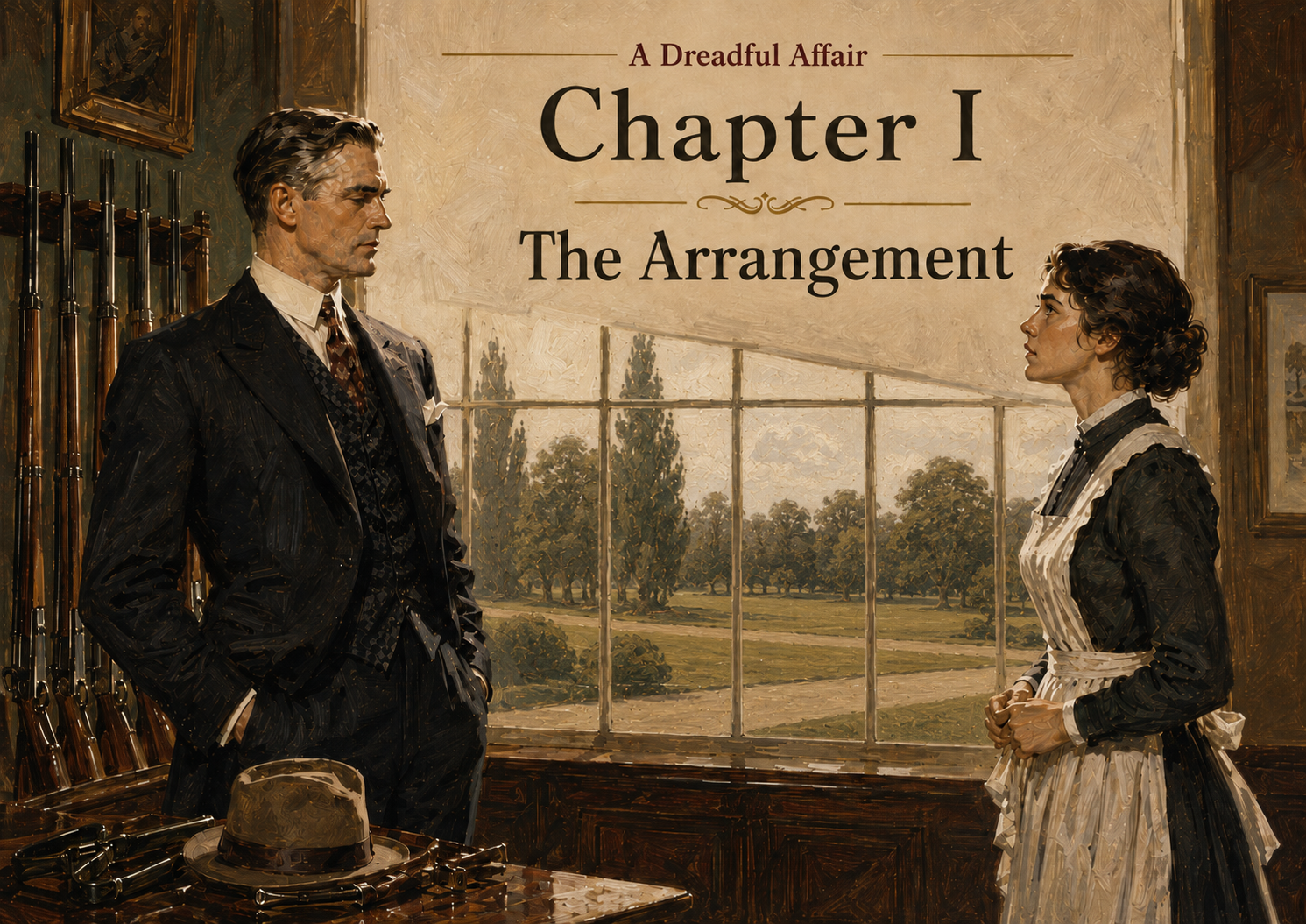
The Arrangement
by adminSir Edwin Harcourt first learned that Alice Mercer was pregnant on a Tuesday afternoon early in March.
She told him in the gun room, which was not a sensible place for the conversation, but she had been waiting outside his study and lost her nerve when she heard Lady Harcourt coming down the stairs. The gun room stood opposite the back passage and was seldom used except in autumn. Alice slipped inside when she saw him and asked him to shut the door.
Edwin did so.
She was twenty-two and worked under Mrs Pearce in the kitchen. She had been at Harcourt a little over two years. Edwin had first noticed her the previous summer when she brought luncheon down to the pond during a shooting party. There was nothing remarkable about her except that she was pretty and knew it. She had dark hair, a broad pleasant face and very good teeth.
At forty-five Edwin was still a handsome man, spare, carefully dressed, with grey beginning at the temples. He moved without hurry and seldom raised his voice. The servants generally considered him particular but fair. If something had been done badly, he generally had it done again.
He was the fourth Harcourt baronet. His great-grandfather, Colonel Sir Matthew Harcourt, had fought in the Peninsula, lost two fingers at Salamanca and afterward served as an equerry to the Prince Regent. Made a baronet in 1818, he bought the mortgaged Bellamy estate the following year and renamed the house Harcourt. The house itself dated from the previous century.
Edwin inherited Harcourt at thirty-two. Since then he had reroofed the west wing, drained the lower paddocks and paid down much of his father’s debt. He considered the estate in better order than when he received it.
Their arrangement had begun some weeks later. Edwin had never regarded himself as having pursued her. He had spoken to Alice when he found her alone, remembered her name after being told it once, and asked whether she liked Harcourt. By the time he first kissed her she had stopped looking surprised when he addressed her. After that he had taken reasonable precautions. He never sent for her directly and did not write to her. They met in the old boathouse, usually after eleven, when the household had settled. Alice had been nervous about it at first, but nervousness had given way to familiarity, and familiarity had encouraged certain assumptions which Edwin had done nothing to correct.
She stood now with her hands folded over her apron and told him she had missed twice. She had thought nothing of it the first time. Now she was certain.
“Does anyone know?”
Alice said nobody did. Not Mrs Pearce, not the other girls, not her family. She had wanted to tell him first.
This was sensible of her.
Edwin went to the window. The lawn was wet after three days of rain. Beyond the yews he could see part of the duck pond, pale beneath the afternoon sky. Everybody called it a pond, though it covered nearly seven acres and had an island in the middle thick with willow and alder. His grandfather had stocked it with carp. Edwin preferred pike.
Edwin asked what she expected him to do. Alice looked surprised and said she did not know. When he asked why she had told him at all, she said, “Because it’s yours.”
There was no accusation in this. If anything, she seemed to think the fact ought to bring them closer together.
“Obviously,” Edwin said.
He sat on the edge of the table and lit a cigarette while Alice tried to explain that she had not meant for it to happen. Neither had he. This appeared to reassure her, which he found extraordinary.
There had been no children in nineteen years of marriage. Penelope had minded at first. Edwin had never seen much use in discussing where the fault lay. Alice’s news settled that much, at least.
The fault had been Penelope’s.
Edwin found the knowledge satisfying.
His wife was not a jealous woman. She had never mistaken Edwin for a warm man, but she considered him dependable. Edwin was fond of her. There were nevertheless limits to what could reasonably be expected of a marriage.
More importantly there was the household. A dismissed kitchen maid was one thing. A pregnant kitchen maid was another. Questions would begin below stairs and eventually reach people whose curiosity Edwin had no wish to satisfy.
Alice came from a village near Shrewsbury. Her father was alive. There were brothers. Money would settle some of the difficulty but not all of it.
Edwin asked when she had last been home. Christmas. Her family did not expect her again until summer.
That was useful.
Alice watched him think. After a while she asked whether he was angry. Edwin said he was not. Anger would have been pointless.
“I’ll see to it,” he said.
Her shoulders relaxed.
“I knew you would.”
The small smile she gave him settled the matter rather more effectively than anything else had.
She believed he was arranging their future.
Edwin had never told Alice that he loved her. He was certain of that. He had called her pretty and once said that he had missed her when she was ill. There had been presents: stockings, a silver compact, five pounds at Christmas. None of these things amounted to a promise. Still, people heard what suited them.
He told her that she would have to leave Harcourt. Not that night, he added, when she looked frightened, but on Thursday morning, before anyone had reason to connect her condition with the house. She must make the departure seem ordinary. Mrs Pearce was to be told there was trouble at home and that she needed to go away for a while. Her trunk could follow once she had somewhere to send it.
Alice listened carefully. This, too, seemed to reassure her. Instructions were apparently what she had wanted.
“Tomorrow night,” Edwin said. “Quarter past eleven. The boathouse. We’ll decide the rest then.”
She nodded.
Before leaving she opened the door only an inch and listened. Then she waited until the passage was empty and slipped out by the servants’ stairs.
Edwin remained where he was.
A cleaning rod had been left across the end of the table. Edwin put it away.
He considered sending her away with money. It would be expensive, but hardly ruinous. The child itself presented no difficulty of inheritance. Even if it were a boy, it could not succeed him. A bastard was a bastard.
That did not make it harmless. Children had an inconvenient habit of acquiring faces. There were doctors who dealt discreetly with such matters; a man Edwin knew at White’s had once been obliged to find one. But that introduced another person and required Alice’s agreement.
A cottage was possible. So were regular payments, some arrangement with her family, or simply dismissal followed by denial. None was impossible.
That was not the same as being satisfactory.
He had no intention of spending the next twenty years maintaining a secret household because a kitchen maid had become pregnant. Nor did he intend to depend upon her gratitude, discretion or future good sense. Alice was fond of him now. That could change.
The pond was deepest beyond the eastern side of the island. He knew this because he had overseen the dredging six years before. The old boathouse contained rope, and the maintenance shed beside it held several iron sash weights left over from work on the west wing.
The solution did not seem particularly complicated.
Edwin finished his cigarette, crushed it into the tray and returned to his study. He rang for tea.
At dinner Penelope was in excellent spirits. The young footman clipped Edwin’s glass with the claret bottle and went white. Edwin steadied the glass with two fingers.
“You’ve saved the carpet,” he said. “We’ll call it a success.”
The boy smiled despite himself and finished pouring.
Penelope had received a letter from her sister and spent several minutes describing some nonsense involving a spaniel and a vase. She maintained a considerable correspondence and generally knew what every cousin, old school friend and former neighbour was doing. Edwin listened, laughed in the proper places and afterward played two games of bezique with her while the wireless gave them dance music from London.
He slept very well.
0 Comments