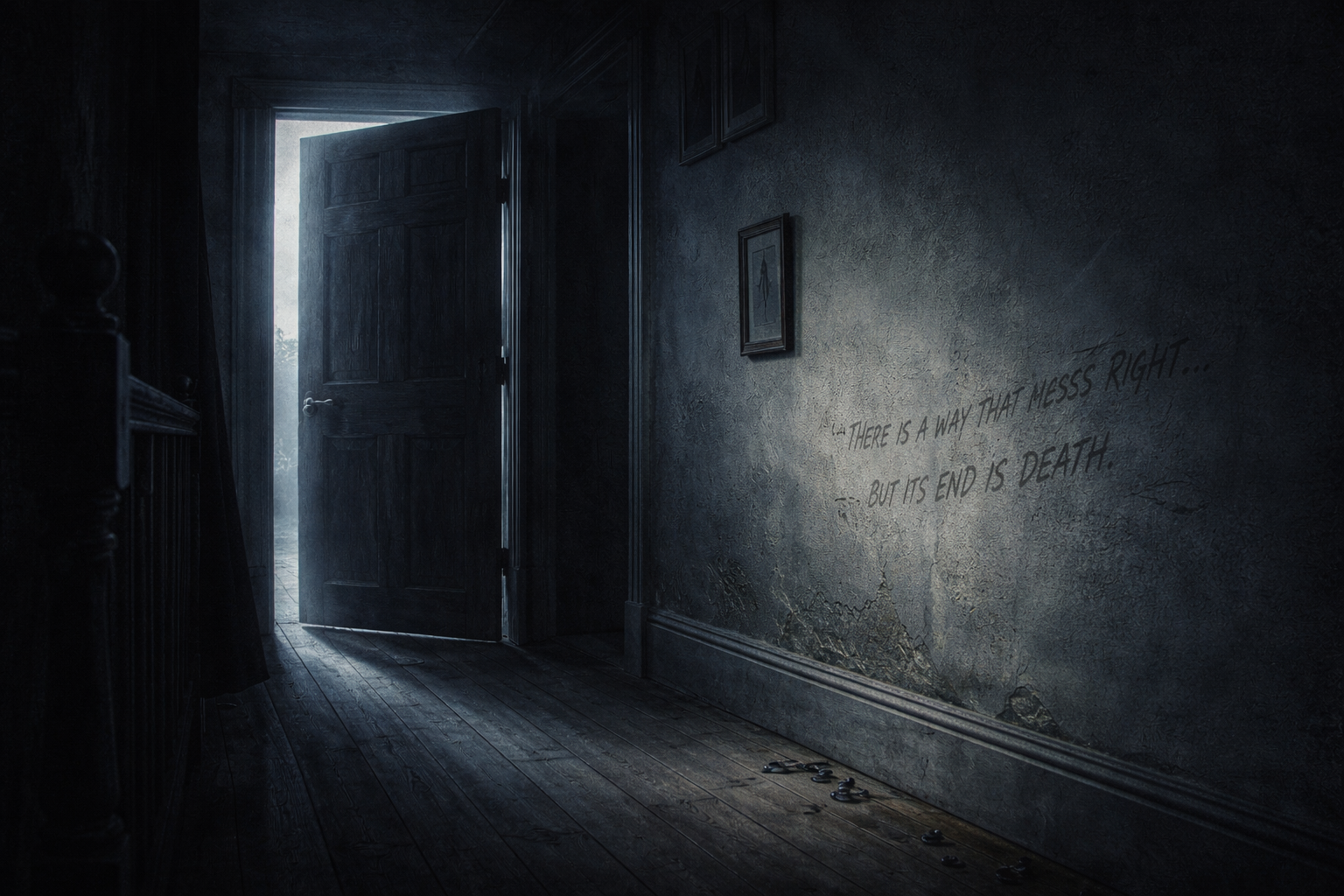
The Lane Closes In
by adminChapter Three
Morning arrived grudgingly.
Kai woke with his jaw aching from sleep he had never quite trusted. For a few seconds he stayed where he was on the narrow bed in the desk room, staring at the strip of grey daylight leaking round the curtain and trying to decide what, exactly, he had heard in the night.
Something moving in the house. That was as much shape as he could honestly give it now.
In daylight it had already started shrinking. The sort of thing tiredness could build out of wind, pipes and an unfamiliar place.
He lay still and listened while the house sorted itself into morning.
Nothing dramatic.
No voices. No knocks. No sound he could point to afterwards and call an event.
Just the old place ticking around him, the radiator making a half-hearted effort, the wind worrying the outside wall.
He sat up.
The room looked smaller by day. Less oppressive. Less impressive, really. The desk was just a desk. The mug with the faded cathedral was where it had been the night before. Caius’s notebook lay beside the Bible, ordinary enough in the morning light to irritate him slightly.
He looked at it for a second too long, then got up and left it alone.
From the front bedroom came a muffled thump, followed by Ellie’s voice.
“If I’ve developed scoliosis in the night, I’m suing the estate.”
That helped.
He ran a hand over his face, opened the door, and stepped onto the landing.
Morning had stripped the place of some of its tricks. The wallpaper was just ugly. The bannister was just old. The stairs descended in a narrow turn to the hall like any other inconvenient stairs in any other draughty house. Even the screwed-shut door looked less like a threat and more like the sort of thing a stubborn old man might do after deciding a problem would improve if it were physically insulted.
Ellie came out tying her hair back with an elastic held between her teeth. She looked wrecked.
“Christ,” Kai said.
“Same to you,” she said. “It’s good we’re both suffering. Makes it communal.”
“You sleep at all?”
“In instalments. Had one dream where Mum was trying to sell the house while we were still in it.”
“That tracks.”
They went downstairs because there was nowhere else to go. The kitchen was cold enough to make both of them move faster than they meant to. Kai put the kettle on. Ellie opened the back door an inch, looked at the weather, and shut it again immediately.
“No,” she said.
“No to what?”
She gestured at the window. “All that.”
Beyond the glass the moor lay in a dirty wash of grey and green, as if colour itself had given up halfway through. The rear wall cut a dark line across it. Beyond that, nothing moved but grass flattening and rising in the wind.
Kai checked his phone out of habit.
Nothing.
Ellie looked at hers and gave a tiny, humourless nod. “Civilisation continues to withhold itself.”
“The router was blinking last night.”
“Yes. Like a dying lighthouse.”
He found the old unit in the front room where they had left it, squatting near the window with its small orange light and offended expression. He rebooted it while Ellie wandered through the downstairs rooms opening cupboards and narrating her findings like a hostile estate agent.
“Three tins of soup, all older than my degree.”
“An entire drawer devoted to string.”
“Tea towels with ducks on them. Disturbing.”
“With enough vinegar to embalm a bishop.”
The house by day was not welcoming, but it was more legible. Not a haunted abstraction. Just an old man’s house with old-man decisions in it. The book spines on the shelves. The stacks of church circulars. The muddy boots by the back door. The umbrella stand with two walking sticks and no umbrella.
Which was, if anything, worse.
The router coughed, blinked, and for one glorious, pointless second Kai’s phone showed a single bar. Then it vanished before anything useful could load.
“Promising,” Ellie said.
“In theory.”
“That bar had no real commitment.”
He gave up and put the phone away.
For a minute or two they just existed in the house. Kettle steaming. Radiators clicking. Ellie opening the wrong drawer and finding batteries, string, a church leaflet, nothing useful. Kai checking the back door again, then feeling faintly stupid for doing so.
It was Ellie who broke the quiet.
“It’s still mad, by the way.”
“What is?”
She leaned against the counter. “Mum. The whole thing.”
Kai got two mugs down from the shelf. “You’ll have to be more specific.”
“She names you after him, or near enough, then spends our whole lives acting as if he’s either dead or infectious. Then he dies and leaves you a house in the middle of nowhere.” She took the mug he handed her. “That is not normal family weirdness. That is a proper old grievance.”
“I’m not named after him.”
“Kai. Caius. It’s the same tune in a slightly pretentious arrangement.”
“It isn’t.”
“It is if you’re not being irritating on purpose.”
The kettle clicked off. Neither of them moved for a second.
Kai poured the water. “Maybe Dad liked the name.”
Ellie gave him a look of almost touching pity. “Dad once wore a maroon fleece for six months because Mum bought it and he didn’t want to upset her. He did not lead a rogue naming strategy.”
That landed because it was probably true.
“There must have been something,” she said, quieter now. “For her to go straight to sell it. Not even ask what it was like. Just get rid of it.”
“She said he was selfish.”
“She says that about anyone who crosses her.”
“She said he went strange.”
Ellie shrugged. “Possible. We are currently in a dead man’s house on a lane called Right Way Lane.”
Kai glanced, without meaning to, toward the ceiling.
The notebook upstairs sat in his head like an unfinished sentence.
“He wrote like someone trying very hard not to sound mad,” he said.
“Which is not the same as not being mad.”
“No.”
She sipped the tea and pulled a face. “Did you ever actually meet him?”
Kai tried to remember. Properly.
“I don’t know,” he said at last. “Maybe once. Maybe not. I’ve got one almost-memory of Mum putting a Christmas card in a drawer and acting like she hadn’t.”
Ellie frowned. “I remember that. Or I remember you remembering it. Hard to tell.”
“That’s healthy.”
“This family is very healthy.”
They took the tea into the front room and stood by the window. Outside, the weather had settled into that particularly British indecision where it was either about to rain properly or had just finished and hadn’t admitted it.
The lane looked less sinister by daylight and more impractical. You could imagine a postman hating it. You could imagine deliveries being abandoned at the wrong gate. You could imagine a man living here too long and beginning to narrate the weather as if it were personal.
The absence of photographs bothered Kai more than anything else. Not even one. No family pictures. No framed holiday. No parish fête nonsense. Nothing that made Caius look anchored to an ordinary life.
“Do you think she cut him off,” Ellie said, “or he cut her off?”
Kai took a sip before answering. “Maybe both. Maybe one of them started it and the other decided to win.”
“That does sound like us.”
He looked at her.
She was trying to be dry about it, but she meant it. So did he.
There was a whole section of their mother’s life that existed only as a tone change. Names she would not say. Places she treated as if they had personally insulted her. A brother who had somehow mattered enough to echo through her first child’s name and yet had been absent enough that both of them had grown up as strangers to him.
“Maybe coming here was a mistake,” Kai said.
Ellie snorted. “Bit late for that.”
“I mean more than physically.”
She watched him for a second. “Maybe. But if we’d sold it blind, you’d have thought about it for the rest of your life.”
Annoyingly accurate.
The phone signal flickered back for half a second, then vanished again before Kai could even unlock the screen.
Ellie pointed at it. “There. Proof God hates us.”
“Or Vodafone.”
“Same basic atmosphere.”
He set the mug down.
“We should go into the village,” he said. “Properly. Get signal. Ring the solicitor. Buy food that wasn’t preserved under Thatcher.”
“Yes,” Ellie said immediately. “And establish whether Right Way Farm is real or whether flat-cap Tom is just local garnish.”
Kai didn’t answer straight away.
Tom had seemed normal enough. Local. Helpful.
Which, out here, was probably half the job description.
Ellie noticed his silence. “You’re defending him already.”
“I’m saying he seemed normal.”
“That’s how people end up in documentaries.”
“He’s a man in a cap, not a forest spirit.”
“Fair.”
They rinsed the mugs, found coats, and moved into that brisk practical mode people adopt when they are trying not to admit they are unsettled. Phone. Keys. Wallet. Charger cable, despite there being nowhere likely to charge it. Solicitor’s letter. Ellie found a packet of biscuits left in the car and declared them emergency provisions.
At the front door she paused and looked back into the hall.
It was only a hall. Narrow, chilly, wallpapered in old intentions. The sort of space an estate agent would describe as having character because the alternatives were too honest.
Kai felt that same faint, contradictory tug he had felt on arrival. Not love. Not comfort. Just the low, disreputable thought beneath everything else.
Still a house.
Still paid for.
Still a possible answer to things.
He hated himself slightly for the thought and locked the door harder than necessary.
Outside, the air had teeth. Fine damp moved across the lane in a drifting mist that could not quite decide whether it wanted to be rain or fog. The moor rolled away in folds and hollows, more visible now than it had been on arrival, but not friendlier for it.
They got in the car.
“Village,” Ellie said.
“Village,” Kai agreed.
He eased the car out through the gate and turned down the lane.
Without dusk and first-arrival nerves, Right Way Lane revealed itself as what it probably was to anyone local: badly maintained, mildly ridiculous, and just wide enough to encourage bad decisions. Cracks ran along the tarmac like old seams. Grass pressed in at the edges. The verges looked soft in places, the sort of soft that could become expensive if trusted.
Ellie had her window open half an inch despite the cold, as if she wanted the outside to prove it existed.
“There,” she said suddenly, pointing ahead. “That definitely wasn’t there yesterday.”
Kai slowed.
At the shallow cutting where the lane dipped between two banks of earth and stone, part of the left-hand side had come down across the road. Not a full landslide. Nothing dramatic. Just a squat spill of mud, broken heather and loose rock spread over half the lane, with a length of weather-faded orange mesh half-caught in it.
Kai stopped the car.
For a moment neither of them spoke.
Then Ellie said, “That is infuriatingly normal.”
It was.
There was nothing theatrical to object to. Roads in bad weather slipped. Banks gave way. Councils ignored minor lanes until somebody important complained. Exactly the sort of thing that could happen anywhere and mean absolutely nothing.
It still felt like being told no.
He killed the engine and got out. The cold in the cutting was sharper, held low between the banks. Mud shifted under his shoes as he walked a few steps towards the blockage. Loose stones clicked down into the drainage ditch.
Ellie came round from the passenger side and stood beside him, hands in pockets.
“Could maybe get past on foot,” she said. “No chance in the car unless your plan is to end up as one of those bouquets tied to a fence.”
Kai looked beyond the slump. The lane carried on a little way, then bent out of sight. Thin strips of mist had begun to gather further on, not thick enough to hide anything, only enough to make distance look unreliable.
“We could walk to the main road,” he said.
“And leave the car here advertising two complete idiots to the countryside?”
A voice called from beyond the slip.
“You won’t get a Fiesta through that unless you’re planning to offer it to geology.”
They both looked up.
On the far side of the mud stood a woman in a navy waterproof with the hood down and a plastic crate braced against one hip. Late fifties, maybe. Square glasses. The sort of expression that suggested other people’s inconvenience was familiar but still faintly interesting.
“Road’s gone again,” she said, with the air of reporting that the kettle had boiled. “Council’ll pretend not to know till Monday.”
Ellie blinked. “That’s reassuring.”
“It shouldn’t be,” the woman said. “You must be Caius’s lot.”
Kai glanced at Ellie. “That obvious, is it?”
“Only car daft enough to try it today.” She adjusted the crate on her hip. “Jean Metcalfe. Shop in Mere Cross.”
Ellie looked at her a second longer. “You left soup in his freezer.”
Jean squinted, then let out a short laugh. “Well. That got about, did it?”
“There was a note,” Kai said.
“Aye, that sounds like me.” Jean nodded toward the slip. “Tom’ll have clocked this already if he’s out and about. He usually does. No one gets trapped up here without the entire area making it a parish concern.”
Before either of them could answer, a figure came along the rise above the wall, steady and unhurried, a shovel resting over one shoulder.
Tom.
In daylight he looked exactly what he claimed to be: a local man with a shovel and somewhere to be.
He gave them a small nod as he drew level with the slip. “Bank comes away there every wet spell worth the name,” he said.
Ellie looked from him to the mud and back again. “That is a spectacularly annoying sentence.”
Tom’s mouth twitched. “You’ll find the area specialises.”
Jean gave a small snort. “He says that like he didn’t spend half of November digging Doris Pike out after she trusted the verge by the cattle grid.”
“Doris trusts anything with edges,” Tom said.
Jean shifted her crate again. “If you do make it down to the village, shop shuts at two, post office shuts whenever Doris feels she’s done enough for civilisation, and the butcher van comes Thursday if he remembers. Today you’re out of luck on most fronts.”
That, more than anything, made the place feel real. Not the moor. Not the blocked lane. A shop with hours, a post office run on mood, a butcher van governed by memory.
Tom came a few steps lower, stopping near enough to be conversational and not near enough to be rude. The shovel made it easier, somehow. A practical object. A man with a job. A reason to be where he was.
“For a motor, you’re done for today,” he said, glancing at the slip. “On foot you could pick past it if you were determined, though it gets slick round the bend and there’s no joy in doing it twice.”
“We only wanted signal,” Kai said. “And a shop.”
“That’s the modern pilgrim’s cry,” Tom said.
Jean rolled her eyes. “Don’t encourage yourself.”
Ellie gave a short laugh despite herself.
Tom shifted the shovel on his shoulder. “If you get truly stuck, phone works at mine when it’s in a generous mood. Better than up here, anyway. Kettle’s usually on.”
Kai opened his mouth, then hesitated.
The idea of trudging two miles through wet ground to a stranger’s place for half a bar of signal and a cup of tea felt suddenly exhausting.
“Thanks,” he said. “Might do.”
Jean tipped her head towards the house. “You’ll manage a day. Caius did it often enough, miserable old stick.”
There was no venom in it. Just local knowledge worn smooth.
“You knew him well?” Kai asked.
Jean gave a little shrug. “Well enough to know he liked marmalade, hated committee meetings, and paid exact change like it was a theological principle.”
That wrong-footed Kai more than it should have.
Tom nodded once. “House warming up at all?”
Kai shrugged. “More or less.”
“Good,” Tom said. “Old places like this can stay cold in the bones if you let them.”
Jean started edging away from the slip. “I’m not standing here discussing architecture till my hands drop off. If you need bread tomorrow, bang on the shop window before ten. After that I make no promises.”
“Comforting,” Ellie said.
“It’s a service economy,” Jean said, deadpan, then turned and made her careful way down the lane.
Tom glanced back towards the blockage. “If you do come down, you’ll go on past the old cattle grid. Lane forks after that. Keep left.”
“Got it,” Kai said.
“Else I’d stay put and give it the day,” Tom said. “No point making a nuisance of yourselves over half a bar and a packet of Hobnobs.”
He said it mildly enough that it could almost have been neighbourly.
The drizzle sharpened, needling at Kai’s coat. He became suddenly aware of how long they had been standing in the lane talking to locals on a road they could not currently drive off.
Tom seemed to notice the moment and save him from it.
“Well,” he said, “I’ll let you be annoyed in private.”
He turned to go, then glanced back at the house on the rise.
“First day’s always the worst in an old place.”
Before either of them could answer, he moved on, boots sure on the wet ground, shovel against his shoulder.
They watched him until he dipped out of sight behind the rise.
“Friendly,” Ellie said.
“Seems it,” Kai said.
They stood another moment by the blockage. Mud glistened. Water trickled somewhere under the loose stones. Nothing about it invited a supernatural reading. That should have reassured him. Instead the ordinariness of it worked against him. The lane had not slammed shut. It had merely become inconvenient.
They got back in and reversed carefully up to the house.
Inside, the hall felt colder after the car. The sort of cold that waited patiently in the walls.
Ellie took off her coat and said, “Right. New plan. We are trapped by weather and minor public-sector failure. Let’s commit to being annoyed by it.”
For a while they did small practical things, the sort that made time pass and stopped thought becoming too theatrical. Kai found the airing cupboard and worked out why one radiator only warmed on one side. Ellie went through the kitchen like an insult with legs and produced half a loaf, a tin of beans, two onions, tea, and a packet of crackers which might yet be legal.
“Luxury,” she announced.
“Whatever we thought when we came, we’re here one more night at most.”
“Then let us dine accordingly.”
Coats on hooks. Bags in rooms. Kettle on. Shoes by the door. A chair moved an inch.
That, Kai realised, was part of what unsettled him. A coat on a hook, shoes by the door, a kettle on, and the place already looked as if it had made room for them.
Worse was how quickly his mind supplied the next steps. A heavier coat. A trip into Mere Cross for proper food. Learning which cupboard the candles lived in, where the roof leaked, how long the tank lasted, when Jean shut the shop, which floorboards not to trust in the dark. It took almost no effort to imagine the house not as Caius’s but as his, and something in that felt less like fantasy than rehearsal.
By midday the weather had settled into a flat damp light that made the windows look older. Kai stood in the front room with his phone by the glass, coaxing signal like a Victorian spiritualist, and managed briefly to load half an email header before the bar died again.
“Anything?” Ellie called from the kitchen.
“One pixel of hope.”
“Can you ring anyone with a pixel?”
“No.”
She came through carrying two mugs and passed him one. “Then stop trying to resurrect the internet by force of will.”
They drank by the window.
Beyond the low wall the moor rolled away in long wet folds. Somewhere down there, supposedly, were a farm, a shop, a post office run by Doris Pike, and an entire minor civilisation continuing without them.
“You believe him?” Ellie asked.
“About the bank? Obviously.”
“About the farm.”
Kai shrugged. “Could be tucked behind a rise somewhere. We didn’t exactly do a survey.”
“Mm.”
“What?”
“Nothing. You’re just doing the reasonable thing very hard.”
Later, rooting through a drawer in the dresser, Kai found an old local map folded soft with age. They spread it on the kitchen table between the mugs.
Contours. Wall lines. One chapel ruin marked in tiny print. The cattle grid further down the lane. The fork beyond. Buildings here and there represented by little black blocks. Nothing labelled clearly enough to settle much of anything. Near where Tom had indicated, there was one square of ink by the bend beyond the fork, too blunt and featureless to prove anything except that something had once existed there long enough to be noticed.
He traced the map again, more irritated than convinced.
Something slipped from the fold and skidded across the table. Kai caught it before it hit the floor.
A Christmas card.
One of those cheap photo ones people used to get run off in town. The picture showed him and Ellie as children in school jumpers, badly lit and over-smiling in the way adults always insisted on. On the back, in their mother’s hand, was a short message:
Merry Christmas. Hope you’re well. Love from all of us.
Nothing more. Nothing dramatic. Just enough to prove that whatever story had settled over this family, silence had not been the whole of it.
“Useful,” Ellie said, then saw his face. “What?”
He turned the card over and passed it to her.
She read it once, then again. “Well,” she said quietly. “That’s interesting.”
“It’s old.”
“Yes.”
“But she did write.”
“Yes.”
He looked at her. “You’re enjoying this.”
“I’m not enjoying it,” she said. “I’m just relieved our family managed one human gesture before recommitting to dysfunction.”
They ate beans on toast in the kitchen because it was there and easy and nobody had the appetite for ambition. Ellie insisted on adding too much pepper. Kai kept thinking about the card when he should have been looking at his food.
By late afternoon the light had gone flat and mean.
They did not go near the screwed-shut room.
That was perhaps the clearest fact of all. In the brisk confidence of late morning it had seemed like an irritating loose end. By evening it had become something else. Not a mystery. A line.
“We go first thing tomorrow,” Kai said as he rinsed the plates. “Walk past the blockage if we have to. Get to the village. Ring the solicitor. Done.”
Ellie nodded at once. “Done.”
It should have felt like relief.
Mostly it did.
And yet the house received the decision without argument. Wind in the eaves. Pipework clicking. Fridge humming to itself in the corner. Nothing dramatic. That quiet acceptance unsettled him more than protest would have done.
They made one last pass round the ground floor before bed. Back door bolted. Windows latched. Hall light off, then on again because Ellie said she refused to break her neck for atmosphere. Kai checked the front door twice and said nothing about it.
At the stairs she paused and looked up.
“Still hate this bit,” she said.
“The stairs?”
“The whole upper floor. Feels like downstairs is where the house performs and upstairs is where it thinks.”
“That’s a terrible sentence.”
“It’s also correct.”
He let her go up first.
The landing held the day’s remaining cold with professional efficiency. The gouged patch at the bottom of the screwed-shut door looked like exactly what he had told himself it was: damage, old wood, nothing. The problem was that he no longer fully trusted the category of nothing in this house.
Ellie stopped outside her room.
“If I hear one weird thing,” she said, “I’m getting in your room and that’s the end of it.”
“Comforting for me.”
“You’re welcome.”
Then, after a beat: “Lock your door.”
It was sensible enough that laughing would have been childish.
“Yeah,” he said.
“Good.”
She went in and shut the door. A moment later light showed under it.
Kai stood alone on the landing for a beat too long, listening.
House. Wind. His own breathing.
Then he went into the desk room and closed the door behind him.
The notebook sat where he had left it, square on the desk beside the Bible. He crossed the room, then stopped short of touching either. Whatever answers Caius had left, he had already taken enough from the day. More would only sharpen the wrong parts of his mind before sleep.
He changed, plugged his phone in out of habit despite the signalless futility of it, and got into bed.
The mattress was no kinder than the one in London, only colder.
For a while he lay staring at the ceiling, following the faint shifts of light as cloud moved across the window. He tried to think about practical things: the solicitor, train times back, whether the car could be left at the village if the lane was still blocked, whether Mum would tell them anything useful once they got home if pressed hard enough.
Instead his mind kept circling smaller things.
The blocked lane.
The old map.
The Christmas card.
The way the house had accepted them.
From somewhere further along the landing came the small, ordinary sound of Ellie putting a glass down on a bedside table. That helped. Proof of another human in the house. Proof that not every sound belonged to the place.
The wind rose and pressed along the gable in a long, low sweep. Something on the roof ticked once, twice, then settled.
Later, much later, he drifted.
0 Comments